

















Digital and Twin Transformation: The Future Model of Living and Production
For quite some time now, the world has been talking about “digital transformation.” We are living in an era where data, connectivity, and automation are at the core of everything—from business processes to everyday life. However, today we have moved one step beyond this transformation. The new concept being discussed is deeper and more impactful: twin transformation.
So, what exactly is twin transformation?
In its simplest form, it refers to creating a digital replica of a physical system, process, or living environment. In other words, we are no longer just managing systems—we are also observing, analyzing, and even predicting their future through their digital counterparts.
From Digital Transformation to Twin Transformation
Digital transformation was primarily about collecting data and optimizing processes. Through sensors, IoT devices, and software, we made systems more efficient. Twin transformation, however, takes this one step further.
We are no longer only discussing the past performance of systems—we are now able to predict their future.
A factory production line, a city’s infrastructure, or a home’s energy usage can all be modeled digitally, allowing potential scenarios to be analyzed in advance.
This means one thing:
We are entering the era of proactive systems, not reactive ones.
Living Spaces Are Evolving Too
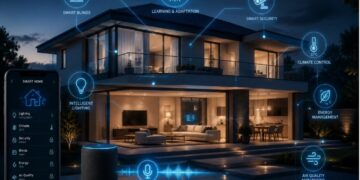
This transformation is not limited to industrial applications. The most significant change is happening in our living spaces. Smart homes have already undergone a major shift with IoT. However, the next phase will take this even further.
Homes will no longer be systems that simply respond to commands.
They will become environments that understand you, learn your habits, and anticipate your needs.
A home that knows when you wake up, how much light you need during the day, and how you prefer your indoor climate… This is no longer a distant vision—it is an imminent reality.
The Connection Between Data and Quality of Life
One of the most powerful aspects of twin transformation is its ability to turn data into meaningful outcomes. Data is no longer collected just for reporting—it is used to enhance quality of life.
Through a digital twin of a living space, it becomes possible to:
- Optimize energy consumption
- Automatically balance light and temperature
- Continuously monitor air quality
- Predict system failures before they occur
This approach transforms comfort from a passive result into a system-driven output.
A Unified Line from Production to Living
Another critical dimension of twin transformation is the stronger connection between production and living environments. Technologies developed through digital twin systems in manufacturing are now directly integrated into our daily lives.
In other words, technology is no longer confined to factories—it is intelligently embedded into life itself.
At this point, technology producers carry a significant responsibility. The goal is no longer just to create devices, but to design systems that make life more efficient, comfortable, and sustainable.
The Çeliker Technology Perspective
At Çeliker Technology, while working on smart home systems for years, we have been observing the foundations of this transformation firsthand. What started with IoT-based solutions is now evolving into data-driven and learning systems.
In every solution we develop, we focus on a simple yet powerful question:
“Does this technology truly make life easier for the user?”
Today, we clearly see that users no longer want just control.
They expect systems to think on their behalf.
And this is exactly where twin transformation delivers its true value.
The Future Model: Self-Aware Systems
In the coming years, the word “smart” alone will no longer be sufficient. Smart systems are quickly becoming the standard. The real differentiator will be systems that understand themselves and their users.
This leads us to a new reality:
The systems of the future will not only operate—they will think.
Conclusion
Digital transformation has brought us to where we are today.
Twin transformation is what will carry us into the future.
The challenge is no longer just to use technology—
but to build systems that can think alongside us.
And perhaps the real question we should now be asking is:
Are we managing technology, or is technology beginning to optimize life on our behalf?